

The Bhagavad Gita, Chapter 2, Verses 28 ... 31
[We have heard Kṛshṇa speaking to Arjuna in the language the ignorant (people of avidya) understand: “For that which is born, death is inevitable for sure; for the dead, birth is also certain. Therefore, you do not have any reason to be upset about this inescapable fact of life.” In the next verse, Bhagavān prepares the ground to switch back to the principle of Ātman by explaining what the ignorant perceive as the birth-death cycle means.]
Translation
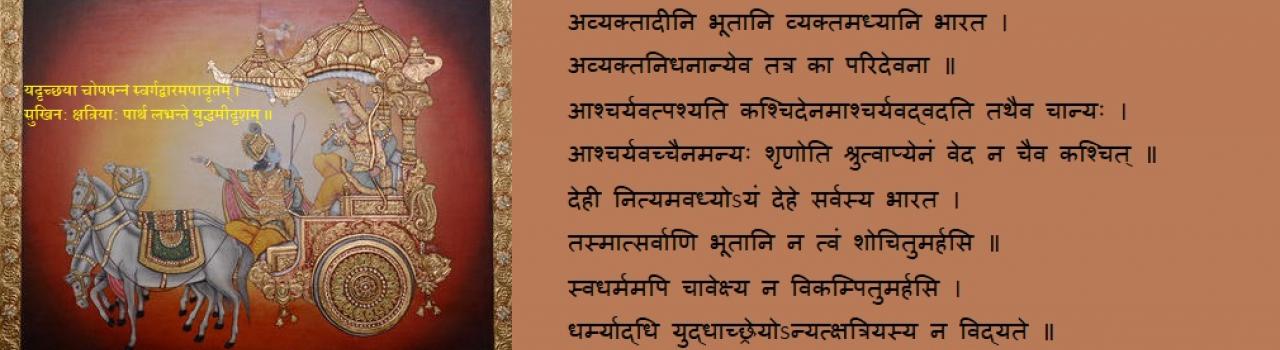
All manifested beings were of obscure origin and are of distinct middle states; and in the end, they again vanish into obscurity. O Descendant of Bharata (Arjuna), what is in that to wail about?
Annotation
“Arjuna, who can tell in which state all the manifest beings were before they appeared in the world? It is true for the universe as well. Can anyone in the world explain from where the universe has come into being? Let me call that unknown state avyakta; it is a state beyond the grasp of human mind, intelligence and sensory perceptions. At the end of their life, those manifested beings again fade into avyakta (obscurity). This is the working process of Nature. Nature has such a system that makes things appear, keeps them for a period in a state that the senses can perceive, and then causes them to disappear. And remember that human beings are integral parts of Nature. If you understand at least this working principle of Nature, O Arjuna, you have no reason to lament the death of the manifested bodies.”
We may note the word bhūtāni (भूतानि), the manifested bodies such as the living beings. This verse describes what is called the process of “becoming” in philosophy. All the entities in the world appear as part of this becoming. This continuous process happens in Nature. We may understand it now as the underlying continuous transformation in Nature. Transformation from what to what? It is from the primal cause to the manifested bodies (bhūtāni). The primal cause is the Reality or Ātman or being. Thus, the continuous transformation is from being to becoming. Although everything we perceive is a bhūta (a manifested body), each such bhūta, as we learned already, is pervaded by Ātman or being. For that reason, a bhūta is referred to commonly as a being (such as a human being). In a being in the manifested form (after becoming), there are essentially two things: (1) an inert body (jada) and (2) Ātman or being or chit. Ātman endows the inert body (jada) with life and a temporal existence, and then the bhūta comes into being.
The foregoing explanation is but a relative way of understanding Truth. Here, the ‘being to becoming’ process is described as a sequential one; it will appear that there is time involved in it. Let us be reminded of Truth, as seen by the seers of Truth (tattva-darśibhih). The domain of Ātman (Truth) is beyond time and space. It will be helpful reading again the discussion we had on verse 16 that the manifest world is the way Ātman (Truth) appears to the sense organs and in Reality neither does any evolution take place nor has any involvement of time. There is no room for a sequential process, either.
[Arjuna may not immediately absorb the principle of Ātman and Its manifestations as described in verse 16, so this ‘provisional’ explanation.]
Translation
Someone sees This (Ātman) as a wonder; similarly, another describes This as a wonder too; yet another hears that This is a wonder. Even after hearing, seeing or having been described, no one understands this Ātman at all.
Annotation
Kṛshṇa coaches Arjuna to appreciate the doctrine of Ātman. “Arjuna, on a close look, every manifested being or phenomenon of the world evokes awe and wonder. The rising and setting of the sun, the stars in the sky, the spinning of the earth, the blooming of a flower, the breath in the beings or anything you name is undeniably a wonder. Do you know why? It is because the Truth behind the world Itself is a wonder! The seers of Truth (tattva-darśibhih) see Ātman as a wonder. If you read the scriptures, the descriptions of Ātman in them also say It is a wonder. And the disciples who go seeking It hear from their teachers (gurus) too that It is a wonder. A wonder is a wonder when it remains a veiled mystery despite all the intriguing experiences it keeps offering. Be aware that the knowers of Ātman are few and far between.”
We consider a thing that is beyond the grasp of the sensory perceptions, mind and intellect a mystery. The inquisitive mind of human beings keeps trying to find the truth behind such mysteries by performing experiments, collecting data from the experiments, analysing the data and arriving at conclusions. The secret behind the universe and life has been elusive to human intellect so far, which leaves scientists often disappointed. The ṛshis who approached the problem differently reached the Truth not by empirical methods but intuitively as an experience. And they have no hesitation in accepting that there is still a mysterious element that evades even the spiritual experience of Truth, as Kṛshṇa implies in this verse.
Further, we have to be cognizant of the fact that the instrument (the body-mind complex) at our disposal is of limited capability to approach the realm of the ultimate Truth. Ātman is not knowable by the sensory perceptions such as seeing and hearing. The mind can, at best, comprehend the bits of information it receives through the sense organs (the input devices) by correlating with those received in the past and stored in the mind-repository. The intellect makes decisions based on such correlated information. The Gita teaches how to overcome the limitation when the seeker is keen to experience Truth.
This is also an early warning that the senses that go after its objects and the mind that becomes attached to those objects act as obstacles in the path of knowing Ātman. Imagine a situation when a man walks at dusk on an ill-lit path; suddenly he is about to step on a snake. His heart misses a few beats and his body turns numb. Fortunately, the instinct to save himself prompts him to step back. Then he lights the lamp on his mobile phone; and heaves a deep sigh. It is only a piece of rope! “Have no blind trust in what the sense organs present to you,” Kṛshṇa warns all of us.
[The substance of the present verse is the same as that of verse 2-7 of Katha Upanishad]
Translation
O Arjuna, this dehī (embodied Ātman), present in the bodies of all beings, is indestructible and eternal. Therefore, you should not grieve for any manifested being.
Annotation
Kṛshṇa summarizes the key points of the discussion in the last four verses, “Arjuna, keep always on top of your mind that it is the same dehī (Ātman) which pervades the bodies of all beings. Even when all the functions of deha (body) come to a complete standstill, either for natural reasons or by any wilful act of mutilation by someone, the eternal dehī (Ātman) remains unimpaired and immutable. The unaffected dehī keeps assuming new deha. Therefore, there is no reason for you to grieve for any manifested beings, rather you should also, like dehī, stay unaffected always because your actual nature is that of dehī, not that of the perishable deha.”
It is time for us to recollect the source of Arjuna’s lamenting over the impending destruction of the two armies. The kshudra samādhi or the short mystic experience. The experience of samādhi, even though short-lived, is not a bad thing at all. Rarely one gets to experience it. But it should not result in distress. Instead, anyone who undergoes a mystic state should be able to take full advantage of it. This is the point Bhagavān has in mind, so he strives and helps Arjuna muster up his mental strength and courage while he is in the short-lived samādhi. We will see shortly how Arjuna should take advantage of what he experiences now.
Now, Kṛshṇa gives a persuasive reason for Arjuna not to grieve and to gather enough courage to face the cause of his distress. Let us hear what Bhagavan says next to raise the spirits of his disciple.
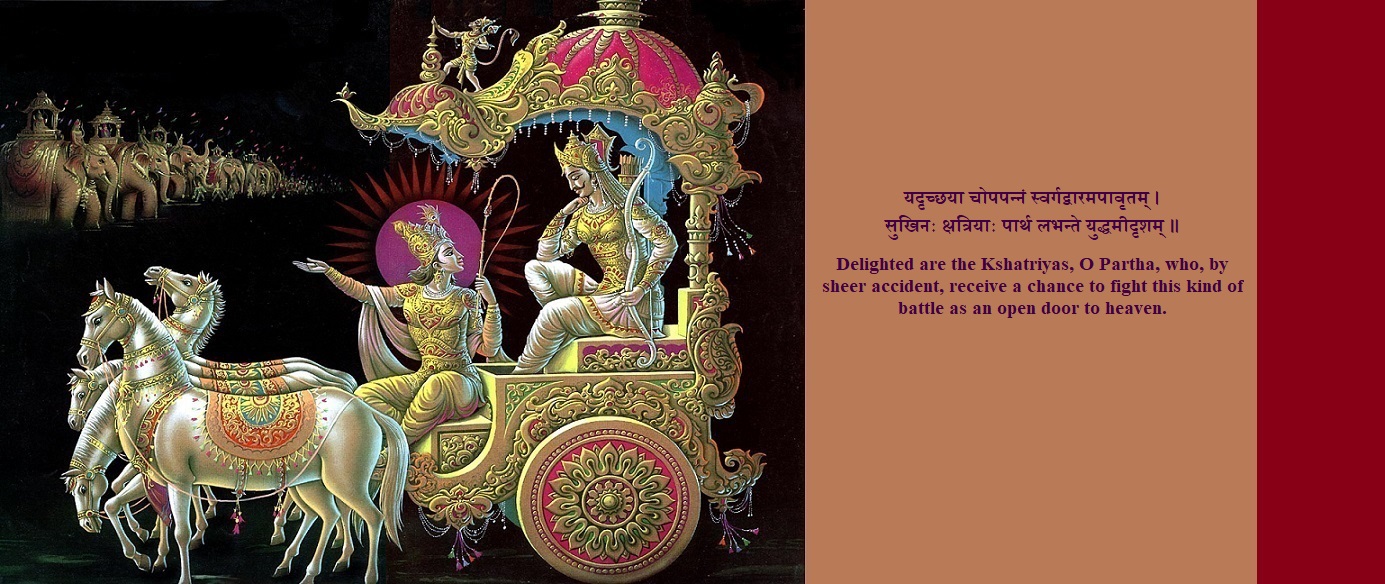
And, even from the point of view of svadharma, you have no reason to be shaken; for nothing else is of Supreme merit for a Kshatriya than fighting a battle that is congruent with dharma.
Annotation
[Svdharama (the natural function or vocation for which one is born) is a concept of great importance in the Bhagavad Gita; later we will find it mentioned in verses 4-13, 11-32 and 18-41. We, therefore, devote a significant amount of effort to gain as much clarity as we can, right in the beginning. It does demand our patience to become reasonably clear about what it means, particularly in Arjuna’s case.]
Dharmyāt yuddham (धर्म्यात् युद्धम्) means the battle that is congruent with dharma; this is one of the most misinterpreted phrases of the Gita to justify the bloody war of the Mahābhārata. When Śri Kṛshṇa teaches the science of Brahman, dharma means only the one we have explained more than once ̶ dharma in the domain of Brahman. And in the domain of Brahman, there are no battles and fights between human beings. It is purely the spiritual domain. Therefore, dharmyāt yuddham has only one meaning here: the spiritual battle.
Let us understand why Bhagavān should imply that the spiritual battle is consistent with a Kshatriya's (here, Arjuna’s) svadharma (the natural vocation for which one is born):
“Arjuna, I am going to teach you now the concept of svadharma. The word may be familiar to you but I would like to emphasize its actual meaning, so please listen carefully.
“Human beings are parts of prakṛti (Nature). Prakṛti (Nature) has an inherent creative urge which always translates into activities (karma). Being part of prakṛti (Nature), human beings also have in them the same urge to be active (to do karma). But the actions of human beings are rarely in accord with the distinct natural function intended by prakṛti (Nature) for each individual. All the same, in order for the seekers of śreyas to succeed, their actions (karma) should agree with their natural function intended by prakṛti. Why? Prakṛti (Nature) itself is the 1creative power of Brahman. In the domain of Brahman, 2dharma refers to the overall life-sustaining functional system of the world (or the universe). The creative urge of prakṛti operates in tune with this dharma.
“Arjuna, now you have heard from me that both prakṛti and the all-sustaining functional system (dharma) belong to Brahman; prakṛti’s activities (karma) are always congruent with dharma. A person’s natural function or vocation (svadharma), as prakṛti (Nature) intends, is also to adhere to the same all-sustaining dharma.
“Thus, in order to fulfil one’s natural function (svadharma), prakṛti (Nature) has endowed every person with certain natural qualities. In life, when one identifies those innate qualities and accordingly engages in the right type of work (karma), adhering to the all-sustaining dharma, then one is said to be performing one’s svadharma. In short, an individual’s natural function or vocation is his or her svadharma. You would not know svadharma as I have explained because it is now widely misinterpreted.”
[1According to Vedanta, prakṛti is not separate from Brahman, but it is the undefinable power of Brahman; it is also called māyā].
[2The original meaning of dharma based on its Sanskrit root is that which supports or sustains.]
“I assume, Arjuna, you are clear about what svadharma is. Then, the second fact I want you to be well aware is what the dharma (functional role) of a Kshatriya is, because you are a Kshatriya yourself. Perhaps you now understand a Kshatriya as a person born to fight battles with the enemies of his kingdom; and people think that by dying in a battle to defend the kingdom, a Kshatriya would qualify to enter heaven. Yet another belief is that anyone who is born in a Kshatriya family is automatically a Kshatriya. I do not blame you if you have had such beliefs because those are the beliefs in the world at present. From my explanation of svadharma, you would have understood that one does not become a Kshatriya by merely being born in a Kshatriya family. Only if prakṛti (Nature) has endowed a person with certain natural qualities to perform the dharma (functional responsibilities) of a Kshatriya, he becomes a genuine Kshatriya. I will equate a genuine Kshatriya with a perfect ruler, not a person born of his or her Kshatriya parents.
“Hey Arjuna, the point I want to elaborate on now is the functional responsibilities (dharma) of a Kshatriya; no one knows today what it really means. 3Kshatriya Dharma comprises (1) the welfare of prajā (the citizens), (2) charity to the deserving, (3) taking instructions on the Vedas, including Vedanta and moving in the path of Supreme wisdom (jñāna) and (4) being completely detached from everything of material or worldly value. 4Śruti says there is none higher than the Kshatriya who adheres to his dharma. Do you think this dharma is to be imposed by anyone? No. It works only if people who are born with the proper qualities (inherited from Nature) have further developed themselves as genuine Kshatriyas through the right education in the śastra-s and become a Brahma-jñānī (knower of Brahman).” [Śastra-s here imply the branches of studies in spiritual and other areas relevant for a Kshatriya]
“Reflect now in the light of what I explained. Is there any reason for you to be upset about your next course of action? The most important responsibility for you from a svadharma point of view is to be always unswerving from the all-sustaining dharma. Based on the facts I explained, if you fight the right battle, nothing else you need to do to attain śreyas, the Supreme merit.” Kṛshṇa, the Jagad Guru, wants to save the world from their misery, so his untiring effort to enlighten them continues.
[Clarifying notes:
3Kshatriya Dharma Chatushṭaya (the four dharmas of a Kshatriya)
Kshatriya Dharma means the functional responsibilities of a Kshatriya; but a close look at these functions will tell us how they are related to the highest level of dharma, which is the absolute dharma (of Brahman) we have discussed earlier. Therefore, the following functional responsibilities (dharma) of the Kshatriyas go well with the context of the Gita.
- Ensuring the complete well-being of prajā (the citizens). (Although the word prajā is now equated to the word citizens, in the present context, it should mean progeny or children. The foremost function of the Kshatriyas, the rulers, is to ensure the wellbeing of the citizens as though they were their own children. Translating Kshatriya as a warrior is not appropriate to interpret the Gita.)
- Dānam: Charity to the deserving. The context: the Brāhmaṇas of the Upanishadic times fully dedicated themselves to perpetuating Vedic wisdom (Brahma-vidya being its core) for the benefit of the entire world, so it was customary for the rulers to be directly responsible for the wellbeing the Brāhmaṇas.
- Vedādhyayanam: Taking instructions on the Vedas, including Brahma-vidya ̶ attaining the supreme wisdom and being a knower of Brahman (Brahma-jñānī).
- Vishaya virakti: Being completely disinterested and detached from everything of worldly values ̶ material gains, objects of pleasure, etc. It means being free from kāma (desires).
(Source: Sabdatārāvali, Sahithya Pravarthaka Co-operative Society, Kerala, India)
An ideal ruler practises all of them of his/her own volition. ]
We note here that waging war and killing are not in accord with the dharma of a Kshatriya. If one fights a battle, it is only with the desire to win, not for its fun. The desire for victory and that for capturing a kingdom or a territory are driven by one’s urge to gratify one’s kāma. There is no physical war and killing if there is no desire of any kind. ‘No desire of any kind’ is vishaya virakti, the fourth dharma of a Kshatriya, just described.
In essence, if all rulers fulfilled their dharma (defined functional responsibilities), there were no reasons for wars. Kshatriya Dharma in its original form did not have fighting battles as a Kshatriya's function. Instead, maintaining a violence-free kingdom (or nation) by protecting the Supreme dharma was a ruler’s key functional responsibility.
When rulers grossly violate the Kshatriya Dharma referred to, the undesirable occurrences of violence and wars become unstoppable. In the philosophy of the Bhagavad Gita, violence and wars are not justifiable; it teaches the way for the world to stay free from violence and wars.
4Brihadāranyaka Upanishad, (1-4-11) says, “In the beginning this was indeed Brahman (the Absolute), just One alone. He specially projects an excellent form, Kshatriya…. Therefore, there is none nobler than the Kshatriya. Hence the Brāhmaṇa worships Kshatriya from a lower position, in the rājasūya yajña….” It implies that the origin of the concept of the Kshatriya class is directly from Brahman itself. It emphasizes the cosmic significance of the role a Kshatriya (to be read as a ruler) has to play in maintaining perfect dharma.
The following verse from Katha Upanishad (II-25) throws light on who a true Kshatriya is:
In this verse, the word brahma (ब्रह्म) represents Pure Consciousness (the knowledge or jñāna aspect of Brahman) and kshatram (क्षत्रम्) the creative power inherent in Brahman. The two aspects together create the appearance of the world. Now, in the relative world, people with the corresponding two qualities help run the matters of the world in accord with the all-sustaining dharma described earlier. A person with pure wisdom-sustaining ability is a Brāhmaṇa (the worldly parallel to Pure Consciousness or jñāna); and one who has life-sustaining ability is a Kshatriya (worldly parallel to kshatram, the creative power of Brahman). In the Upanishadic context, the ṛshis are the examples of genuine Brāhmaṇas and King Janaka is an example of such a Kshatriya. (Kṛshṇa himself later mentions the name Janaka). Therefore, these two kinds of people together not only support normal life in the physical world but also untiringly endeavor to ensure the total welfare of the world. Further, this Upanishadic verse shows that these two kinds of people are perfectly suited to pursue the path of Brahman.
If this discussion has conveyed at least a rough or even a vague idea of the functional responsibility (dharma) of a Kshatriya (or his svadharma), its purpose is served. The gaps in the understanding will be covered when we take up the next verse for study.
When Kṛshṇa tells Arjuna that he should engage himself in the dharmyāt yuddham (धर्म्यात् युद्धम्), Bhagavān reminds him of his svadharma and advises him to adhere resolutely to the all-sustaining dharma.
What then could be this dharmyāt yuddham? We translated it as a battle that is congruent with dharma. Is it the Mahābhārata war? Let us investigate a little further.
To the seekers of supreme wisdom (jñāna), the well-known six-fold enemies are:
Anyone who lives with full unfeigned experience that all beings are, in essence, the same Ātman, would have triumphed over these six-fold enemies. Arjuna has had a trance (kshudra samādhi), but that is only a fleeting one. Once out of it, these enemies will still hold him in captivity, so he must fight them.
The source or the cause of the six enemies is one’s ego-identity (ahaṅkāra) and, therefore, conquering one’s own ego-identity is the most effective way to be rid of those obstacles. Thus, we gain a vague sense of what the term dharmyāt yuddham (a battle that is congruent with dharma) means; freeing oneself of one’s ego-identity (ahaṅkāra) calls for a titanic struggle. [Ego-identity is a firmly established mind-set of ‘I’, ‘my’, ‘mine’, ‘I am this body-mind complex’, and ‘I must grab everything that pleases my body-mind complex’. It is the false identity an ordinary individual carries because of the false notion that he or she is the body. A Brahma-jñānī has gotten rid of the ego-identity and stays in his or her genuine identity, which is Ātman alone.]
This background will enable us to enjoy what Bhagavān says in the next verse.
-----------------------------------


Leave a comment